Showing posts with label 1930's. Show all posts

April 8, 2012

Folk Song Collectors

As a little girl my aunt taught me a beautiful German folk song. The song "Es waren zwei Koningskinder"  tells the tale of a prince and princess who wanted to be together, but both tragically died as they tried to swim towards each other on a large river.  It must have been about 25 years ago when my aunt taught me this song, but it stuck with me ever since.  

German Folk Song - "Es waren zwei Koningskinder" 


Despite its beauty, folk music seems to be something of the past and many folk songs have disappeared with time. Thankfully, John Lomax shared my love and appreciation for traditional folk music. During the 1930's and 40's he traveled extensively throughout the United States and recorded thousands of these hidden treasures. Lomax visited small towns in the Apalachian mountains to hear old British and Irish folk songs, and went to prisons in the South to discover black folk music. 

It was in one these prisons in the early 1930's that Lomax discovered Leadbelly, a black outlaw who had been in prison before and who was now charged with attempted homicide. It was said that thanks to Lomax, Leadbelly was able to leave prison earlier. Right after he was released from prison, the two of them traveled throughout the US to let Americans hear "negro music". In the video below you can see the real Lomax and Leadbelly and hear part of Leadbelly's most famous song "Goodnight Irene"  

John Lomax: Leadbelly - "Goodnight Irene" 


John's son Alan Lomax accompanied his father during many of his travels and decided at a young age that he would follow in his fathers footsteps. Alan Lomax not only traveled the US to find folk songs, but he also visited several European countries. He continued to collect folk songs until the 1980's, and eventually recorded many songs for the US Library of Congress. This year Alan Lomax's entire collection was made open to the public. On the website Cultural Equity  17,000 recordings collected by Alan and his father can be heard.  Let's hope that through this website, traditional folk music will never completely disappear.

Alan Lomax


February 26, 2012

The Era of "The Artist"; a Soundtrack to the 1920's and 1930's

This weekend I finally saw "The Artist" and I loved it! "The Artist" depicts the disappearance of silent movies and the emergence of the first talking pictures during the 1920's and 1930's. "The Jazz Singer" which was released in 1927, was the first popular talking picture. Very soon all silent movies were considered to be too old fashioned, leaving musicians which accompanied these movies without a job. Movie Companies, however, were forced to rehire these musicians to make soundtracks, and thankfully music continued to be an important part of movies.

The roaring twenties was the decade of Prohibition (in which manufacturing, importing, exporting, selling and transporting alcohol was banned by law in the U.S.), the emergence of the phonograph and the first record studios, and of course the great crash of 1929. By the 1930's Big Bands headed by great musicians such as Duke Ellington, Cab Calloway, Tommy Dorsey were the talk of the town. It was also the decade in which The Grand Ole Opry was first broadcasted throughout the entire US, and Billboard published its first list to aid jukebox owners in their music choice.

The 1920's and 1930's also brought forward some of the greatest artists of the 20th century. We all still know and love Bessie Smith, Louis Armstrong,  Jimmie Rodgers, Bing Crosby, Fred Astaire, Billie Holiday and of course the amazing Cole Porter. Here are some of my favorite songs from these two decades. All of these songs were used in movie soundtracks.


Bessie Smith - "St. Louis Blues" (1929)


Jimmie Rodgers - "Waiting for a Train" (1930)


Fred Astaire - "Dancing Cheeck to Cheeck" (1935)


February 12, 2012

One of the Most Covered Songs in History

A few years ago the British newspaper The Indepedent published a list of the ten most covered songs in history:

1. Eleanor Rigby - The Beatles
2.Yesterday - The Beatles
3. Cry me a River -  Julie Londen
4. And I Love Her - The Beatles
5. (I Can't Get No) Satisfaction - The Rolling Stones
6. Imagine - John Lennon
7. Summertime - Abbie Mitchell
8. Blackbird - The Beatles
9. Over the Rainbow - Judy Garland
10. The Look of Love - Dusty Springfield

This blog post is about number 7 on this list: "Summertime". I have to admit I've never heard of Abbie Mitchell's version of "Summertime", nor had I ever heard of Abbie Mitchell before. But her rendition of the song is how Gershwin originally intented it to be, and it is indeed beautiful. In 1933 Gerswin wrote the opera Porgy and Bess and included the lullaby "Summertime". The character Clara sings this song at the start, and its melody can be heard several times throughout the opera. In 1935, when Porgy and Bess was first performed on stage, Abbie Mitchell played Clara's part. Mitchell recorded the first version of "Summertime", and 38,324 recordings of the song were made after Mitchell's version.

In 1936, Billie Holiday's cover of "Summertime" was the first that entered the American music charts. About two decades later, Ella Fitzgerald and Lois Armstrong also recorded an excellent rendition of the song. Their version became that popular, that most people actually think that Fitzgerald and Armstrong were the first who recorded this song.

Ella Fitzgerald and Lois Armstrong - "Summertime"


Since "Summertime" was recorded many times and by so many different people, it was done in an enormous variety of styles. Janis Joplin's version of the song is one of my favorites. She is one of few people who were able to add an extra dimension to an already beautiful song.

Janis Joplin - "Summertime"


I won't bother you here with all the 38,325 recorded covers of this song, but if you're interested check this website which lists them all. Miles Davis, Sam Cooke, Billy Stewart and Scarlett Johansson were among the many to record "Summertime"

You may also like:

January 29, 2012

The Highest Paid Black Entertainer Of The 1920's

It is impossible to write about the essentials of music, without mentioning Bessie Smith. She died at the age of 43 in a car accident, but has left several wonderful songs for us to hear. Throughout the 1920's and 1930's she recorded a large number of "race records" (as they were called back then), and she became the highest paid black entertainer of her time.

Careless Love is my favorite Bessie Smith song. No one knows who wrote the song and at what exact time period, but many of the great artists have decided to add the song to their repertoire (Louis Armstrong, Odetta, and Ray Charles among others).

Whenever I listen to Bessie Smith I can't help but feel like I'm thrown right back to her era. As if I'm standing in a dark alley in some southern town in the US. A late summer evening, and her music playing from inside a house. I hope you'll enjoy this song as much as I do.

                                                         Bessie Smith - "Careless Love"


You may also like:
The Woman Who Discovered Bing Crosby, Frank Sinatra, Billie Holiday 
The Era of "The Artist": a Soundtrack to the 1920's and 1930's 
One of the Most Covered Songs in History 

December 27, 2011

The Woman Who Discovered Bing Crosby, Frank Sinatra and Billie Holiday

They say that if it wasn't for this woman, there wouldn't be a Bing Crosby, a Frank Sinatra or a Billie Holiday. She was the one who discovered these giants in music and gave them a platform to show what they have in store. Bing Crosby was actually one of her brother's friends. They both visited Mildred Bailey while she was working as a singer in LA, and after hearing him sing, she decided to introduce him to some of the important names in music at that time.

Mildred Bailey was the Amy Winehouse of the 1930's and 1940's. She was married three times before the age of 35. She was known for her bad mouthing, and instead of drinking and drug-abuse she was a huge food addict.  Her health got so bad at one point, that she was hospitalized. Because she had spend all the money she made throughout the years, Bing Crosby and Frank Sinatra offered to pay for her hospital bills.

Nevertheless, her music was considered to be among the greatest of her time, and has influenced many great singers after her. She was known as Mrs. Swing, and as "The Rockin Chair Lady (after her 1932 hit "Rockin Chair" written by Hoagie Carmichael) and recorded several big hits. I especially like two of the many songs she recorded. "I'm Nobody's Baby" (made famous by Judy Garland in 1940), and "I let a Song Out of My Heart" (one of Duke Ellington's hits). Enjoy!


"Mildred Bailey - I'm Nobody's Baby"


Mildred Bailey - "I Let a Song Go Out of My Heart"


You may also like:
The Era of "The Artist": a Soundtrack to the 1920's and 1930's
One of the Most Covered Songs in History 
The First Lady of Song

December 18, 2011

Music That Makes Me Happy

I hardly ever tell anyone that I listen to music from the Andrews Sisters. First of all because they are not that widely known in Europe, and second because people look at me as if I'm a little crazy if I let them hear this music. I think it's a shame. It does sound very 1940's, but that doesn't mean that it isn't any good. It always makes me happy when I hear their songs. That may be one of the reasons why their music was so big during one of the most difficult period of world history.

During the second world war, when most American men were at war oversees, The Andrews Sisters were enormously popular in the US. Their popularity already started in 1937 with their hit single "Bei Mir Bist du Schoen". This song, originally part of a Yiddish musical, was translated into English (without the writers' consent) and brought The Andrews Sisters immediate fame. They were the first famale vocale group ever to win a gold record. Strangely enough, this song was also quite popular in Germany, that was untill the Germans discovered it was written by Jewish people. 

Their popularity lasted from 1937 - 1951 and the group had an average of eight hit songs a year.They really were the face of the World War II period, and they could be seen everywhere at that time. Next to the all the songs that were recorded, they made movies, went to several military bases, and had their own radio show. They were often dressed in navy clothing to support the war effort.

Songs such as "Boogie Woogie Bugle Boy", ""Shoo-Shoo Baby", and  "Rum and Coca Cola" were not only extremely cachy in the 1940's, but (according to me) are still very good 70 years later. Let me know what you think. 

The Andrews Sisters - "Boogie Woogie Bugle Boy"


December 7, 2011

A History of Bluegrass ( Part 2)

By the time the folk music scene regained its popularity in the late 1950's, most famous Bluegrass singers  had lost their contracts and radio's stopped playing their music. Many folk singers, however, were heavily influenced by the Bluegrass style, and decided to bring this music back to the public. Moreover, in 1962 Flatt & Scrugs were asked to sing the theme song for the popular TV show The Beverly Hillbillies ("The Ballad of Jed Clampett"). They had no idea that by doing this, people would  forever identify bluegrass music with trashy white people. 

This revival of Bluegrass during the 1960's allowed some great old time Bluegrass singers to display their music to an entirely new audience. The Stanley Brothers and Bill Monroe were among those. The Louvin Brothers were another brother duo that regained popularity, be it on a small scale. Although they sing a number of different musical styles, I personally like the Bluegrass versions of their songs best. "I Don't Believe You've Met My Baby" is one of my (and my father in laws') favorites. 

From the late 1960's until the late 1990's Bluegrass continued to be played, although it was largely overshadowed by other more popular music styles. During this time several country singers recorded Bluegrass albums (listen to Dolly Parton's Bluegrass Collection). The real revival, however, came in the early 2000's with the soundtrack of the movie "Oh Brother Where Art Thou". Some of the biggest stars in Bluegrass and Country music can be heared on this cd (Ralph Stanley, Alison Krauss, Gillian Welch, Emmylou Harris and the Carter Family). It also includes some bands which didn't achieve national fame yet, but rightfully did through this album (The Whites and the Cox Family). Thankfully, these artists didn't stop after the Oh Brother Soundtrack. The cd compilation "Down From the Mountain" is another one of my Bluegrass favorites, and includes many of the artists that are included in the Oh Brother Soundtrack.

Below you will find "I'm A Man of Constant Sorrow", the old time tradional folk song which Ralph Stanley brought to national fame. This is actually not really George Clooney singing, but Dan Triminsky, a musician in Alison Krauss' Union Station. Notice the woman at the beginning who's asking for the Soggy Bottom Boys, that's Gillian Welch :-). More about her will follow soon.

The Soggy Bottom Boys - "I'm a Man of Constant Sorrow"


December 5, 2011

A History of Bluegrass (Part 1)

As you may have already noticed I am a enormous fan of Bluegrass music. To me, Bluegrass represents music at its core. It's where all the good things in music come together. I love the vocal harmonies in bluegrass, as well as the splendid blending of different acoustic instruments; the banjo, steel / acoustic guitar, mandonline, fiddle, and the dobro.

The man who started this all was Bill Monroe. He grew up in the early part of the last century, when Bluegrass music did not even excist.  Bill Monroe was very interested in traditional music, and was inspired by a variety of musical genres; blues, jazz, country and Victorian parlor songs. He released his first record with his brother Charlie in 1936; "What Would You Give in Exchange for Your Soul". It became a big hit in the Southeastern states of the US, and brought instant fame to the Monroe Brothers. After several severe fights with his brother, Bill decided it was best for them to part. He soon started a new band; Bill Monroe and the Blue Grass Boys. 

Bill Monroe and the Blue Grass Boys produced several big hits.  In 1940 they released a redo of Jimmie Rodger's "Mule Skinner Blues" which became very popular. Their 1946 hit "Blue Moon of Kentucky" did even better, and has since been covered by Elvis Presley, Patsy Cline and Bob Dylan (to name just a few).  It was in these two song that the Bill Monroe style was perfected. Soon Bill Monroe and his Blue Grass Boys became regulars at the Grand Ole Opry. While Bill Monroe continued to be a constant factor in his band, the Blue Grass Boys were continually replaced. Two of his former band mates that were able to also make a big name for themselves were Lester Flatt and Earl Scruggs. They started their own band The Foggy Mountain Boys and became quite famous for their hit "Foggy Mountain Breakdown"" (if you think you know how to play the guitar, try playing this song). Bill Monroe received the Grammy Lifetime Achievement Award in 1993, just a few years before he died in 1996.
"Oh, (Monroe) was the first. But it wasn't called bluegrass back then. It was just called old time mountain hillbilly music. When they started doing the bluegrass festivals in 1965, everybody got together and wanted to know what to call the show, y'know. It was decided that since Bill was the oldest man, and was from the Bluegrass state of Kentucky and he had the Blue Grass Boys, it would be called 'bluegrass.'' - Ralph Stanley
Ralph Stanley, another big name in Bluegrass, was very much influenced by Bill Monroe (although Stanley never wanted to admit this).  Ralph Stanley started performing with his brother Carter at around the same time Bill Monroe did. Even though Bluegrass wasn't really known to be a musical genre back then, the Stanley brothers copied a lot of things that Bill Monroe and his band did at the time. What the Stanley Brothers did seem to work, they became almost as popular as Monroe was. The song "Man of Constant Sorrow" (a traditional folk song) was one of their biggest hits, which Ralph continued playing after his brother died in 1966. In 2004 the song was again introduced in the soundtrack of  the movie "Oh Brother Where Art Thou".

Several "Bluegrass" musicians lost their record deals in the late 1950's. This type of music was now seen as too old-fashioned and way too hillbilly. It wasn't, however, the end of Bluegrass. More information on how Bluegrass Came About will follow soon.

Bill Monroe - "Blue Moon of Kentucky"


You may also like:
A History of Bluegrass (Part 2)
My Love Letter to Alison Krauss 
Harmony Singing 

December 3, 2011

Anything Goes

"In olden days a glimpse of stocking
Was looked on as something shocking,
But now, God knows,
Anything Goes"

The last line, taken from Cole Porter's famous song "Anything Goes", sums up this songwriter's lifestyle very well. Cole Porter knew what he was writing about. His well to do upbringing helped him to live an outrageous lifestyle. He was known for his partying, travels to foreign countries, and numerous gay and bisexual escapades. 

Cole Porter was born in the state of Indiana in 1891. His father was a shy and reserved man, his mother a dominant character, who wanted nothing but the best for her son. She spend a great deal of time and money to be able to make her son succesful in life. He learned to play the violin and the piano by age 10, and his mother helped him write his first operette at about the same age. Cole Porter studies at Yale and entered Harvard Law School, but soon decided that this was not for him, and studied music instead.

He wrote his first musicals soon after he graduated from Harvard's Music Faculty, and pretty soon was recognized by critics as well as the general public. His musical "Anything Goes" was a Broadway hit in 1934 and is still performed in theatres thoughout the United States.

I first saw "Anything Goes" in a small theatre in New Jersey in 2004, and was blown away. Not so much for its storyline (because I thought the storyline was rather bad), but because of  6 songs in this musical which I loved (and still do to this day); "I Get a Kick out of You"; "You're the Top"; "It's De-Lovely"; "Let's Misbehave"; "Blow Gabriel Blow", and of course "Anything Goes". Can you imagine, 6 great songs, in just one musical!

Hopefully I was able to transfer some of my Cole Porter enthusiasm to you. If so, you might like to watch this 2004 movie about Cole Porter's life, buy this great CD, or visit this website where you can find everything worth knowing about Cole Porter, as well as the songs and musicals he wrote, and the important books and movies about his life. But, first, take some time to listen to Pati Lupone's version of  "Anything Goes'" performed at the Toni Awards in 1988. 

Patti Lupone - "Anything Goes"


October 22, 2010

The First Lady of Song

This is a blog about music. All kinds of Music. Pop. Rock. Folk. Blues. Country. Jazz. etc. etc. .... You name it, and it will be here. I will show some of the coolest You Tube videos. Give a few history lessons in music. Discuss some great songs. But most of all, will just let you enjoy the essentials of music (Music-Essentials). 

Perhaps I ought to start with something about me. I’m a 29 year old girl/woman, and have been in love with music ever since I can remember.  As I was born in 1981, my first  real music memories were from about 1989. I was 8 years old back then, and vividly remember Tina Turner’s “Simply the Best”, Cher’s “If I Could Turn Back Time”, Michael Jackson’s “Smooth Criminal”. Remember?? Of course, you do! 

Up untill I was about 24 I only listened to top 40 (pop) music, but then discovered that people also made music before I was  born! I started listening to country music (especially bluegrass), but also took more interest in Gospel music, (hard) rock, jazz, blues, classical music, hiphop, and actually just about any kind of music there is out there. What I also discovered at that age, is that there are so many music genres I didn´t even know about, (including lots and lots and lots of singers), and am still discovering as of today. So, feel free to send me any great music you think others might appreciate too. As this is my first blog post, I won´t give you my entire (musical) history yet, but will share more about me in future blogposts.  

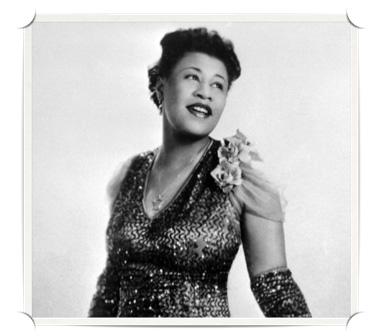
Now, to kick of with something really groovy, which also truly expresses how I feel about music, I give you Ella Fitzgerald (a quite aged version of the First Lady of Song) with ... . Aaaaah, 


 Some facts you might want to know before you watch this great video:

♪ Ella Fitzgerald was born in 1917 and died in 1996 at the age of 79.
♪ Here first big hit was “A-Tisket A-Tasket” all the way back from 1938
♪ This was about too years after she was discovered at the famous Apollo Theatre in Harlem (New York)
♪ She recorded quite a few popular albums with Louis Armstrong 
♪ In her lifetime she won a total of 13 grammys
♪ Check this website to retrieve more information on Mrs. Fitzgerald
♪ Or, even better, watch this great documentary from BBC Four on her extraordinary life
♪ The following song is a Duke Ellington original 
♪ (Don't be impatient, the real singing will start at 1.59, but I just love her introduction)